THE first bicycles were made of wood. Cycle manufacturers then switched to steel tubes. These days, for high-end bikes where weight is at a premium, they use aluminium alloys or even carbon fibre. But Izhar Gafni, an amateur cyclist who owns a number of such fancy bikes, wonders whether the original inventors had a point. He proposes to go back to using wood—or, rather, a derivative of wood, namely cardboard.Mr Gafni, who is based in Ahituv, Israel, spent years trying to work out how to make a cardboard bicycle able to support the weight of a human being. The trick is twofold. First, he folds the cardboard—commercial-grade material, made from recycled paper—to increase its strength. (He worked out the exact pattern of folding for each of the machine’s components using the principles of origami.) Then, once it is folded, he treats the result with a proprietary resin that holds it in shape and stiffens it, before cutting it into the form of the component required. A second application of resin renders the component waterproof, and a lick of lacquer makes it look good. The result, Mr Gafni claims, is stronger than carbon fibre.
The bike’s frame, wheels, handlebars and saddle are all made of cardboard in this way, and then fitted together. The tyres—again harking back to the early days of cycling—are composed of solid rubber, which is recycled from old car tyres. That makes the ride a little harder than if the tyres were pneumatic, but means they cannot be punctured.
The chain, based on the timing belt of a car, is also made from car-tyre rubber. The pedals are plastic recycled from bottles and the brakes are recycled too, though Mr Gafni is not yet ready to disclose the details. The finished product weighs 9kg, a bit less than an ordinary bike, and can carry a rider weighing 220kg.
Mr Gafni’s target market is the poorer countries of the world. Because manufacturing the cardboard bike will, he reckons, cost $9-12 a unit, his design is far more affordable than a steel-framed bike.
Wednesday, 6 February 2013
Re-cycling: The Cardboard Bicycle
Wednesday, 30 January 2013
The Bicycle Barometer
The bicycle barometer takes data about the weather, the status of the tube lines I use to get to work, and whether my local station is open or shut.It then reduces all that data down to a single value and displays it on a dial with a bike sign at one end and a tube sign at the other.
For example, if it is raining a bit the dial will move a bit towards the tube sign, but if the tube is suffering delays, it will move a bit back in the other direction.
Different data points get different weightings. E.g. snow is more important than a bit of drizzle; the tube station being shut trumps everything.
It is built using a Nanode and an old clock I found at a flea market. The data comes from the Met Office’s Datapoint API and Transport for London’s line status and station status API’s.
The code, instructions and design for building one are available here: https://github.com/memespring/bicycle-barometer
Wednesday, 26 September 2012
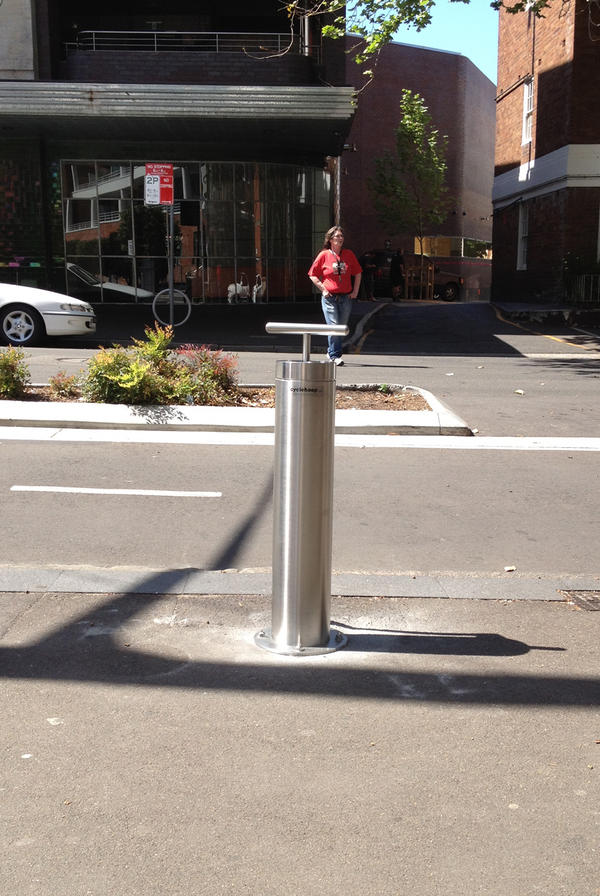
Street Pump Sighting In Surry Hills
Need air? Here's our new on street bicycle pump on Bourke St, Surry Hills. More coming soon!
Saturday, 29 October 2011
Danny Macaskills's Ride
Every time I see another video of Scottish trials phenom Danny MacAskill pogoing his bike off two-story buildings, I marvel not only at his skills but also at his bike. I mean, what kind of bike can stand up to that sort of abuse without quickly being reduced to a pile of bent rims, broken hubs, and cracked metal?
UK bike manufacturer Inspired Bicycles, which has sponsored MacAskill since 2007, answered that question last week with the public release of the Skye, the 24-inch-wheeled bike that the 25-year-old rode in both his Way Back Home and Industrial Revolutions videos. Named after the small island in Scotland from which MacAskill hales, the Skye is a burly aluminum frame that features a one-piece bottom bracket and chainstay yoke and through axles both front (20mm) and rear (12mm). It comes equipped with MacAskill's component picks, including custom Hope Pro 2 Evo and Pro 2 Trials hubs, a Hope stem, and Atomlab rims. It tips the scales at 26.3 pounds, which might seem hefty but I suppose that's partly what makes it so durable.
Thursday, 22 September 2011
New York City Bike Share Program Will Have 10,000 Bikes, 600 Stations
Last year, we heard that New York City was considering a huge bike sharing program and now it's becoming a reality. New details have been released about the program and it's just as big as had been hoped. There will be about 600 stations with 10,000 bikes and the program could be up and running by next summer.
The stations will be widespread, covering the Upper East and West sides all the way down to the tip of Manhattan and then across the East River into Brooklyn as far as Greenpoint and Crown Heights.
The city has chosen Alta Bike Share to install and operate the system. Alta operates bike share programs in Washington, D.C., Boston and Portland, but the New York system will dwarf those systems by a few thousand bikes, making it the largest in the country. Above is a video featuring the Capital Bikeshare program in D.C.
The program will allow for 24-hour, multi-day or annual subscriptions as well as shorter rentals charged by the half-hour. Monthly subscriptions will be cheaper than a monthly MetroCard.