And yet you’d need to be wearing a tinfoil hat to believe there’s anything to chemtrails…
Friday, 28 September 2012
Tinfoil Humour
Thursday, 27 September 2012
How High Oil Prices Will Permanently Cap Economic Growth
For most of the last century, cheap oil powered global economic growth. But in the last decade, the price of oil has quadrupled, and that shift will permanently shackle the growth potential of the world’s economies.The countries guzzling the most oil are taking the biggest hits to potential economic growth. That’s sobering news for the U.S., which consumes almost a fifth of the oil used in the world every day. Not long ago, when oil was $20 a barrel, the U.S. was the locomotive of global economic growth; the federal government was running budget surpluses; the jobless rate at the beginning of the last decade was at a 40-year low. Now, growth is stalled, the deficit is more than $1 trillion and almost 13 million Americans are unemployed.
And the U.S. isn’t the only country getting squeezed. From Europe to Japan, governments are struggling to restore growth. But the economic remedies being used are doing more harm than good, based as they are on a fundamental belief that economic growth can return to its former strength. Central bankers and policy makers have failed to fully recognize the suffocating impact of $100-a-barrel oil.
Running huge budget deficits and keeping borrowing costs at record lows are only compounding current problems. These policies cannot be long-term substitutes for cheap oil because an economy can’t grow if it can no longer afford to burn the fuel on which it runs. The end of growth means governments will need to radically change how economies are managed. Fiscal and monetary policies need to be recalibrated to account for slower potential growth rates.
Wednesday, 26 September 2012
A 3D Printer That Uses Bioplastic
Dutch architecture firm DUS has developed The KamerMaker (RoomBuilder) – a 3D printer so large that it can create entire rooms! Dubbed by its creators the “world’s first movable pavilion,” the KamerMaker features an enlarged ‘Ultimaker’ 3D printing machine that is so big it’s actually capable of printing smaller pavilions. In fact, it is capable of printing objects as large as 7.2 feet by 7.2 feet by 11.4 feet. Not only that, but the large-scale 3D printer can produce objects made from corn bio-plastic.
UK overseas gas imports to surge to $11 billion by 2015
Britain's natural gas imports from outside the North Sea will surpass domestic production by 2015 and add more than $11 billion to import costs as domestic supplies dwindle and Norway increasingly struggles to fill the gap, Reuters research shows.Estimates show that Britain's own gas supplies will fall from around 43 billion cubic metres (bcm) per year today to around 16 bcm in 2030 if they continue their average annual 5 percent decline since peaking in 2000, while demand is set to hold steady between 85 and 95 bcm.
Britain was a net exporter of gas until 2004, but a steady decline in output over the last few years has made it more reliant on imports, which have so far mostly come from Norway and, increasingly, Qatar.
South Korea Plans 200-Megawatt Tidal-Power Plant by 2016
South Korea plans to build a tidal- energy plant on the southern tip of the peninsula by 2016, saving an estimated 330,000 metric tons of greenhouse gas emissions a year.South Jeolla province signed an initial agreement with Korea Electric Power Corp. (KEP), Korea Midland Power Co. and five other companies to build the 200-megawatt plant in Jindo, the provincial government said in an e-mailed statement without giving cost estimates.
A Melting Greenland Weighs Perils Against Potential
As icebergs in the Kayak Harbor pop and hiss while melting away, this remote Arctic town and its culture are also disappearing in a changing climate.Reuters is quoting an FT interview with Total's chief saying that oil extraction in Greenland is a bad idea - Total chief warns against Arctic drilling: FTNarsaq’s largest employer, a shrimp factory, closed a few years ago after the crustaceans fled north to cooler water. Where once there were eight commercial fishing vessels, there is now one.
As a result, the population here, one of southern Greenland’s major towns, has been halved to 1,500 in just a decade. Suicides are up.
“Fishing is the heart of this town,” said Hans Kaspersen, 63, a fisherman. “Lots of people have lost their livelihoods.”
But even as warming temperatures are upending traditional Greenlandic life, they are also offering up intriguing new opportunities for this state of 57,000 — perhaps nowhere more so than here in Narsaq.
Vast new deposits of minerals and gems are being discovered as Greenland’s massive ice cap recedes, forming the basis of a potentially lucrative mining industry.
One of the world’s largest deposits of rare earth metals — essential for manufacturing cellphones, wind turbines and electric cars — sits just outside Narsaq.
This could be momentous for Greenland, which has long relied on half a billion dollars a year in welfare payments from Denmark, its parent state. Mining profits could help Greenland become economically self sufficient, and may someday even render it the first sovereign nation created by global warming.
“One of our goals is to obtain independence,” said Vittus Qujaukitsoq, a prominent labor union leader.
But the rapid transition from a society of individual fishermen and hunters to an economy supported by corporate mining raises difficult questions. How would Greenland’s insular settlements tolerate an influx of thousands of Polish or Chinese construction workers, as has been proposed? Will mining despoil a natural environment essential to Greenland’s national identity — the whales and seals, the silent icy fjords, and mythic polar bears? Can fishermen reinvent themselves as miners?
“I think mining will be the future, but this is a difficult phase,” said Jens B. Frederiksen, Greenland’s housing and infrastructure minister and a deputy premier. “It’s a plan that not everyone wants. It’s about traditions, the freedom of a boat, family professions.”
The Arctic is warming even faster than other parts of the planet, and the rapidly melting ice is causing alarm among scientists about sea-level rise. In northeastern Greenland, average yearly temperature have risen 4.5 degrees in the past 15 years, and scientists predict the area could warm by 14 to 21 degrees by the end of the century.
Energy companies should not drill for crude oil in Arctic waters because the environmental risks are too high, Total SA Chief Executive Officer Christophe de Margerie said in the Financial Times on Wednesday. The newspaper described de Margerie's comments as the first time a major oil company has publicly criticised offshore exploration in the Arctic.The risk of an oil spill in such an environmentally sensitive area was simply too high, according to de Margerie. "Oil on Greenland would be a disaster. A leak would do too much damage to the image of the company," he said.
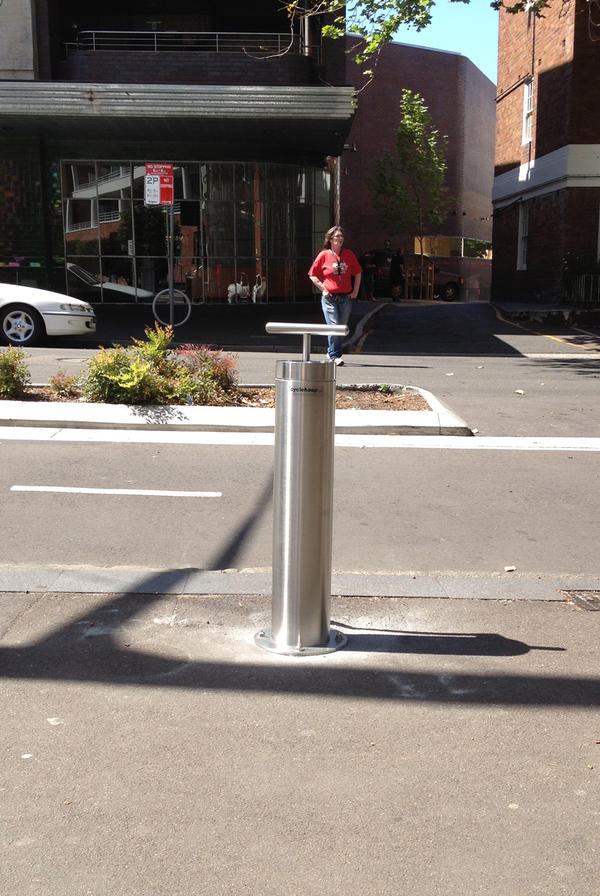
Street Pump Sighting In Surry Hills
Need air? Here's our new on street bicycle pump on Bourke St, Surry Hills. More coming soon!